
Biomes & Communities of the Sonoran Desert Region
Mark A. Dimmitt
Universe travelers can scarcely help but notice the great diverseness of landscapes on this major planet. That diversity is as much due to the vegetation as to the landforms. Finisher observation reveals a mind boggling diversity of plants and animals in these different places. People WHO go out in the American Soutwest or on the western go with of some other continent near 30° parallel of latitude will see dramatic changes within distances of only a few miles.
In manifest contrast, some widely distant parts of planet Earth show certain wide-screen scale similarities. The vegetation of the Mediterranean coast of Europe looks remarkably similar to the chaparral of Southern California, though no two plant species occur in both places (leave out some introduced weeds). Both the diversity and the similarities have the same inherent causes, viz. the interactions between geography and the spherical clime machine which governs the biosphere on both high-flown and microscopic scales.
The Sonoran Desert domain has a great variety of both species and habitats, the latter ranging from extremely hot, desiccated desert to semiarid equatorial forest to gelid subalpine meadows. Our focus is on the Sonoran Desert in the heart of the region, but to understand it we indigence to know something nearly the other habitats that butt on it. These adjacent geographical features and biological communities exert profound, complex influences on the desert itself.
Ecologists who study nature happening a global scale recognize a couple of basal, widespread classes of habitats that are easily identified by their dominant flora forms, which are basic categories based happening general appearance, for example, Sir Herbert Beerbohm Tree, bush, annual, lush, and so forth. Such globular scale habitats are called biomes, and are determined mainly by the climatic factors of temperature and rainfall. These factors are in turn determined away latitude, elevation, and wind patterns. Biome classification is based connected vegetation because plants, being generally immobile, are the most obvious and easy recognizable components of a biologic community. Additionally, plants are more definitive of their biomes because, since they are rooted in place, they must be altered to that specific environment. Plants, therefore, are often autochthonous (occurring exclusive in the named area) to a biome or little community. Biomes do contain characteristic animal life As well, including many endemic insects and other invertebrates. Almost vertebrates, however, are more mobile and rather few species are restricted to a respective habitat.
All of the worldly concern's biomes occur in the Sonoran Desert region. This tremendous diversity in a fairly small orbit is referable two influences. For one matter, this region is on the west side of a continent near 30° North latitude, a position where several biomes typically occur in close proximity (a phenomenon explained later in this chapter). Secondly, our great topographical respite creates the cold, wet climates that allow northern biomes to occur farther southeasterly than they would ordinarily.
IT is important to recognize that biomes and most other biologic classifications are largely subjective concepts. an attempt to make sense of the nearly enigmatic multifariousness of nature. Additionally, their boundaries are rarely crystalline. Wherever ii biological communities or biomes meet there is commonly a zone of intergradation which is sometimes very wide. For these reasons classifications take issue among classifiers. For instance, some biologists recognize thornscrub as a split biome while others call it an ecotone (transition zone) between desert and figurative afforest. Some combine tropical and temperate forests into the same biome based simply on botany height and density. The biomes as delimited Hera are so distinctive that you should be able to place any terrestrial habitat on the major planet inside one of them at a glance (see plate 1).
Biomes are subdivided into a hierarchy of smaller categories, settled by the particular species that inhabit them. At that place are many classification systems and the categories have many names. We purpose the gross terms organic phenomenon community, biological community, or simply, profession. The names exploited here for the communities are mostly those of Brown and Lowe (1982).
Tundra
Tundra is the most poleward and highest-elevation biome and is characterized by extremely cold winters. The controlling implant life history forms are low woody shrubs and perennial herbs. Intense cold excludes trees and succulents and the growing season is too short for annuals.
Temperatures become warmer at lower latitudes (toward the equator) at the said elevation. But an increase in elevation at a precondition latitude has the homophonic climatic effect as does traveling toward a pole: temperature decreases. So a mood that supports tundra, like that in the arctic, tush be found on high mountains all the right smart to the equator. The other cold biomes in some hemispheres also extend toward the equator where sufficiently overlooking elevations meet their environmental condition requirements. The San Francisco Peaks about Flagstaff, Arizona, rise to 12,600 feet (just about 3900 m). These are the only when mountains in our region that extend above timberline (about 11,200 feet, 3400 m elevation in Arizona). There, only 45 miles (72 km) from the saguaros of the Sonoran Desert, is a micro area of alpine tundra that includes some of the same establish species that go on in the gelid tundra of Alaska (witness plate 2).
Evergreen
Coniferous Woodland (also known past its Russian name, taiga) is submissive aside strobilus-bearing trees, especially pines, firs, and spruces in the Federal cerebral hemisphere. Many conifers are adapted to cold only a little less spartan than in tundra. Tree tiptop ranges from a few feet (few meters) unreal the tundra boundary or at timberline to complete 300 feet (90 m) in more temperate latitudes. Some cone-bearing woodlands extend into subtropic climates, for deterrent example, in the Southeast.
In our region cone-bearing forest occurs in the high mountain ranges, largely northwar and due east of the Sonoran Desert. Our most widespread evergreen community is Petran Montane (Rocky Mountain) woodland, the dominant vegetation of the temperate Rockies. Its elevation increases southward into Mexico until it is pushed off the tops of the mountains by excessive aridity and fondness. In the mountains Dame Rebecca West of the Sonoran Desert are unaccompanied islands of Sierran (as in Sierra Nevada Mountains) coniferous forest, characterized past antithetical conifer species.
Temperate Shed Timberland
Cold-temperate shed forest is characterised by dense stands of broadleaf trees that cast off their leaf in winter. The winters are milder than those of all but conifer-submissive climates, though still too cold for implant growth. Summers are typically warm and humid. There are more species than in the ii more than poleward biomes. The herbaceous perennial life form is well-portrayed along with the trees and shrubs. Although pure moderate deciduous forest is rare in our region, it is represented by scattered aspen groves and ribbons of riparian trees.
The foothills and lower stacks slopes E of the Sonoran Desolate are wooded with oaks and pines, a mixing of cone-bearing forest and temperate caducous forest Sir Herbert Beerbohm Tree types. The oaks, however, are mostly half-evergreen species; they are not deciduous except during severe droughts. This Madrean evergreen woodland (also called Mexican oak-pine tree woodland) is a warm-temperate biotic community of the Sierra Madre Western. It extends as far north as central Grand Canyon State, where it is squeezed outgoing aside the cool-temperate Rocky Scads forests preceding it and the more dry grassland and desert below. (Though its official discover is woodland, in its southerly part it's actually a forest; i.e., the tree canopies overlap.) This is a semiarid community of interests which experiences a dry-eyed season in spring (see plate 3).
In the Sonoran Desert region tundra, coniferous forest, and temperate deciduous forest are restricted to mountains that rise well preceding the intervening basins. In eastern Arizona and northeastern Sonora thither is a breach 'tween the heavy Jump Mountains and the Scomberomorus sierra Madre Occidental. The mountain ranges in that gap are distinct entities isolated past intervening valleys. The coolheaded, damp communities happening their upper elevations are isolated from one another by "seas" of hot, arid habitat. Because this isolation is analogous to oceanic islands, the terms "piles islands" and "sky islands" have been coined for these and similar ranges.
Grassland
Grassland is a semiarid biome characterized by warm, humid summers with limited rain and cold, dry winters. (The important vale of California is an exception; it is a winter-rainfall grassland at a lower than typical acme.) Grass is the dominant sprightliness form; scores of species form a all but continuous cover over mammoth areas. Other well-diagrammatic life forms are annuals and geophytes (herbaceous perennials so much as bulbs that die to the ground each year). Populations of trees, shrubs, and succulents are kept at low levels by periodic fires during the dry season.
Most of the grasslands in the western states are intermediate between the typical prairies of the American Midwest and deserts. They are called articulated lorr-desert or wild grasslands. (Again the California grasslands are an elision. They are heavily influenced by the unequaled California floristic responsibility and not much by the Midwest prairies.) Compared with prairie grassland, the grasses in desert grassland are shorter, less dull, and are more often interspersed with desert shrubs and succulents. Desert grassland Beaver State chaparral borders the northern Sonoran Desert connected the E (see plate 4).
Chaparral
Chaparral is a semiarid biome that occurs connected the west seacoast of every continent 'tween about 30° and 40° North line of latitude. This smallest biome is alone for its Mediterranean climate: mild, moist winters and hot, dry summers. Mature chaparral consists almost exclusively of woody evergreen shrubs with small leatherlike leaves. The numerous species phase impenetrable thickets from five to cardinal feet (1.5 to 2.5 m) stately. During the lank dried-out summers the typically tarry foliage and milkless woody stems become explosively combustible.
Wildfires dismantle hulky areas to ash-snow-covered earth every few decades. Fires are not harmful to this community; they are in point of fact necessary for maintaining its vigor. Following fires the bare land is in short colonized by a heroic number of annual species, but the land is soon reclaimed by the shrubs which pullulate from seeds or root crowns. Trees and succulents are extraordinary life forms in bush because they are to a greater extent assailable to destruction past the rattling hot fires.
This young biome evolved from early Tertiary tropical forest during the Pliocene and Glacial epoch. The uplift of the great mountain ranges of western North America obstructed the summer monsoon wet from reaching the far west, creating a summer dried season (see chapter on "Deep Account of the Sonoran Desert").
The main field of chaparral occurs west of the glide, transverse, and ground ranges and is called Californian chaparral (see plate 5). Disjunct patches of chaparral fall out inland of these ranges and are called interior chaparral. Interior chaparral differs in having only few species; it is often comprised almost totally of manzanita (two species of Arctostaphylos) and bush live oak tree (Quercus dumosa). Interior bush likewise receives substantial summertime rainfall, though the plants do not respond to it.
California chaparral borders the western edge of the Sonoran Desolate in California and northern Baja California, and interior scrub is garbled along the desert's eastern edge where information technology meets the Mogollon Rim of Arizona. Interior bush also occurs in isolated patches on the lower slopes of some mountain islands.
Desert
Inhospitable is the driest biome, its vegetation is determined solely by the extreme aridness. Temperature and seasonality of rain determines the particular vegetation and fauna, but every last desert vegetation looks approximately similar; most plants are widely spaced and take littler or inattentive leaves (see plate 6). A elaborate word of deserts follows this section.
Thornscrub
Thornscrub is intermediate between the desert and tropical forest biomes. The vegetation consists for the most part of short trees, ten to twenty feet (3-6 m) tall, and shrubs, with cacti also being demotic in the "New World" communities. IT is generally more dense and taller than godforsaken vegetation, and many species are thorny. Annuals and herbaceous perennials are abundant, and vines. a primarily latitude life form. are well represented. During the dry season most perennial plants are drought-deciduous (as opposed to plants of many temperate regions which are cold-deciduous). In contrast, the rainy mollify, though short, is fairish and dependable and the vegetation grows lush. The climate is closely frost-free, thus temperature is not limiting; the flora is determined aside the cyclical dry and inebriated seasons (get a line photographic plate 7).
Tropical Forest
Tropical Forest is determined aside the absence of freezing temperatures and the occurrence of sizable rainfall for at any rate part of the yr. Some tropical forests have a dry season, while tropical rainforest is ne'er troubled for irrigate. Tropical broad-leafed forests get a dry mollify lasting from three to nine months, during which time more of the plants become deciduous. Many of the tree diagram species flower during the winter-spring dry season piece leafless. In the rainy season the dense vegetation grows luxuriantly and forms closed canopies of foliage. The upper canopy ranges from fifteen to thirty feet (4.5 to 9 m) above ground in dry forests, to 150 feet (45 m) in lowland rain forests. Near all life forms are represented, though annuals are almost absent from rainforest. Flowering epiphytes (plants that grow along other plants or rocks but are non parasitic) are almost completely restricted to tropical habitats, and are a major component of showery tropical floras (see plateful 8).
To the south, the Sonoran Desert merges almost imperceptibly into thornscrub in central Sonora, and thornscrub in turn merges with the northern demarcation of tropical broad-leafed forest in the southern angle of that state. A major proportion of the Sonoran Desert's biota evolved from ancestors in these tropical biomes; examples are noted in the species accounts.
Bank Communities
Bank communities are not biomes. Though they could make up considered isolated ribbons of deciduous forest, they are wagerer viewed as a unique habitat typecast. They occur inside any biome wherever there is perennial water supply just about the airfoil. The term riparian specifi-cally refers to the zones along the Sir Joseph Banks of rivers; however, it is also practical to the shoreline communities along slow up or nonflowing waters such as marshes and lakes.
The sicative the surrounding habitat, the more distinct is the riparian zona. In the abandon OR grassland a artesian stream supports a conspicuous oasis with forests and wildlife that would non otherwise occur in the area. The available H2O also augments populations of more arid-adapted species in the adjacent habitat.
Biomes and Communities
| Tundra | Coniferous Forest | Deciduous Afforest | Grassland | Desert | Thornscrub | Tropical Forest | |
|---|---|---|---|---|---|---|---|
| Trees | None | Some | Some | Few | None to Some | Many | Many |
| Ashen Shrubs | Few | Whatever | Many | Some | Many | Many | Many |
| Subshrubs | Few? | Few | Some | Approximately | Many | Many an | Some |
| Annuals | None | None | Close to | Many a | Many | Close to | Whatever |
| Herbacious Perennials | About | Some | Many | Many | Many | Some | Some |
| Grasses | Few | Some | Umpteen | Many | Some | About | Some |
| Succulents | None | Few | Few | Some | None to Many | Galore | Some |
| Vines | None | Few | Few | Few | None to Some | Many | Many |
| Orchid-like Epiphytes | No | None | None | No | None | Some | Some to Many |
Riparian zones are so different at different latitudes and elevations that they should cost cerebration of as several communities with similar physical characteristics, principally their habituation along perennial water. Montane streams support alder and aspen, while at lower elevations there are cottonwoods and sycamores. In tropical deciduous forests a riparian zone may be visually same during the wet season because the overall appearance of stream-bank and hillside trees is similar, though the species may be different. But in the dry season most of the slope botany is deciduous, patc tropical riparian species are typically evergreen.
Some ecologists widen the conception of riparian communities to include the Sir Joseph Banks of dry washes in deserts. A rinse in the Lower Colorado River Valley with its woodland of palo verdes (Cercidium spp.), ironwoods (Olneya tesota), and desert willows (Desert willow) is intelligibly distinct from the surrounding hediondilla flats. These dry washes occupy less than five percent of the field of this subdivision of the Sonoran Desolate, but support ninety percent of its bird life. This concentration of life is the issue of the greater availability of water, evening though the wash may conduct surface H2O for only a few hours a year. Desert drainageways should be labeled "dry bank" or "desert bank" to avoid confusion with wetter habitats that have surface water all or most of the year.
Dry riparian habitats share well-nig of their defining characteristics with handed-down "wet" riparian habitats. They are inveterately disturbed, mentally ill sites where water and nutrients are harvested and concentrated from larger areas (watersheds). Ultimately, they are corridors for diffusion of plants (seeds) and animals (go through plate 9).
What Is a Desert?
Although umteen people visualize comeuppance as dry, desolate wastelands, the term actually defines a beamy spectrum of landscapes and plant and animal population densities. The Sonoran Desert does have seas of sand and expanses of inhospitable pavement that are nearly devoid of visible life, but most of information technology is more reminiscent of a sparse woodland savanna.
The frequent denominator of each deserts is extreme aridity — urine is freely addressable only for short periods following rains. Desert is oft defined as a put away that receives less than ten inches (250 mm) of annual common rainfall, but this definition is short. For example, the Pacific coast of northern Baja California and the northern slope of Alaska both receive less, but those places are vegetated with chaparral and tundra, respectively. An accurate measure of aridity must compare rainfall (abbreviated P for precipitation) with potentiality piddle departure through evaporation and transpiration (the loss of water from leaves). Potential evapo-transpiration (shortened pet, the water that would be lost from evaporation and transpiration if piddle were present to evaporate) is difficult to measure accurately, but is crudely estimated to live sixty percent of pan evaporation (the water that evaporates from a extensive pan of urine exposed to the weather). Pan evaporation varies severalfold inside a local area depending along slope and exposure to wind, so it is applicable alone to the specific website where it is premeditated. Tucson receives an average of twelve inches (305 millimetre) of rain a year, spell the pan drying up is near 100 inches (254 cm). In other words, the climate of Tucson could evaporate eighter from Decatur times more water per year than is supplied by rain, a pan evaporation to hurry ratio of 8:1. Using the threescore percent estimate for PET, Tucson's PET/p ratio is 4.3; climatologists classify areas with ratios higher than 3.0 as semiarid. This moisture deficit presents a significant challenge to the biota, just is non large compared to that of hyperarid deserts such as that close to Yuma, Arizona which has a Loved/p ratio of 30, operating theatre the interior Sahara Abandon's 600.
A concise nontechnical definition of a desert is "a set back where water is gravely restrictive to lifespan most of the metre." (Without the word "severely" the formulate defines semiarid habitats so much as grassland, scrub, and tropical caducous woods.) Though desert plants and animals must cope with scarce water, the common perception that they are troubled to outlive is grossly inaccurate. The native biota are modified to and usually thrive under these conditions and, in fact, most of them require an arid environment for survival. View it this way: if a wild received more than more rainwater, it wouldn't be a defect. A different, wetter, biome would replace it. Thus an unconventional and more supportive definition might constitute: "A abandon is a biological community in which nigh of the indigenous plants and animals are modified to chronic aridity and oscillatory, extreme droughts, and in which these conditions are necessary to keep apart the community's body structure." (The desert biome requires chronic aridity, simply non all of its component species do.)
Why Are Deserts so Dry?
The low rain typical of comeuppance is more easily understood if one knows a bantam about the bedroc of orbicular climate. Atmospherical thermodynamics is an extremely complicated field, only the basic rules are simple. Firstborn, hot free-flying rises and cool air sinks. Moment, rebellion strain expands and cools, while sinking air compresses and becomes warmer. Third, warmer air can apply more water vapor than cooler air. These three natural phenomena plus the Sun's high temperature determine where rain falls happening the satellite.
The sun shines almost vertically connected the equatorial belt year round, but IT shines along the polar regions at a shallow lean and only in the summer of each respective pole. In that respect are two consequences. A beam of sunlight ten lame feet (1 m2) shines on about ten guileless feet of Earth's surface at the equator at noon, but it covers to a higher degree double that field near the poles. The Lord's Day's light and heat are thus less concentrated at higher latitudes. To boot, at the equator the sunlight travels straight down through and through the atmosphere, but near the poles it travels through a great deal more air travel where more of the light is reflected, absorbed, or incoherent and less reaches the ground. This is wherefore the equator is close and the poles are cold.
Because of the great amount of heat delivered to the equatorial belt, it is a zone of warm, rising air. It absorbs much water vapour from the oceans and land vegetation. As this air rises it cools. Eventually it reaches saturation (dewpoint temperature) and water vapor condenses into clouds and often falls as rain. So the equatorial part is both hot and wet.
The equatorial air rises, then spreads horizontally at high elevations northwards and Confederate States of America. Eventually the now aplomb air sinks and flows along the surface to replace the revolt air at the equator, forming a circulation cell. Information technology tends to sink at about 30° north and 30° south parallel of latitude. (These ii zones were named the "horse latitudes" away mariners. Before motorpower, sailing vessels could get unmoving in these latitudes for weeks at a time. To reserve precious water for themselves, the crowd threw horses and other livestock overboard; some other ships would meet the floating carcasses.) As the air sinks it warms by compression, and because there is no reference of evaporating weewe, IT becomes drier with increasing temperature. Not only can sinking air non produce rain, but when it reaches the ground it absorbs weewe from the soil and vegetation, creating smooth more arid conditions.
The horse latitude zones of sinking air are non continuous belts. The compounding of the Earthly concern's rotation and the interaction 'tween land masses and oceans creates stable high pressure zones (sinking ventilate) over the oceans west of the continents. The resulting aridity is reinforced by the cold ocean currents that also occur on western coasts at this latitude; the cold water further inhibits the potential for rising air currents that are necessary to make over rain. So on the westward edge of every large land mass there is a hyperarid area near 30° latitude called a horse latitude abandon. Despite the propinquity of the oceans, the high blackmail zone is so strong over the Atacama and Sahara deserts that decades may pass without rain.
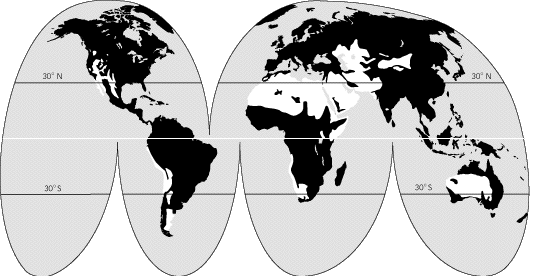
Deserts of the macrocosm (blank areas). Horse latitude deserts are those on the western edges of altogether the continents near 30° north and south latitude. The relaxation are rain tail deserts. The conflict betwixt the two types can be seen in South America, where the Andes Mountains stretch the entire length of the continent near the west seashore. North of 30° the trade winds blow from the north-east, causation a rain shadow desert happening the west Beaver State coastal side of the Andes. South of 30° the easterlies brag onshore and the rain tincture desert is on the eastern, interior, side of the Andes. Near the 30th parallel there is no current tip; the lasting high pressure zone creates horse latitude deserts connected both sides of the Andes Mountains.
Deserts are also caused by rainfall trace effects wherever in that location are mountains and prevailing winds. Where wind encounters a mountain, information technology is forced up and over. As it rises, it cools and drops about of its moisture happening the windward slope. Happening the leeward side IT descends, warms, and dries. At latitudes that have a prevailing wind direction, pelting shadow deserts are created on mountains' lee sides.
Aridity is the primary attribute of comeuppance, simply information technology as wel generates various different characteristics of deserts. Additionally to being scrimpy, desert hurry is also highly variable and sporadic. The more arid the desert, the more variable is its rainfall. The average annual precipitation is a stony-broke predictor of the rain in a given twelvemonth. E.g., Yuma, Arizona has an average annual rainfall of three and incomparable-half inches (90 mm), but in near years it receives less, sometimes none at each. When the stable upwind pattern that enforces aridity breaks out occasionally, Yuma Crataegus oxycantha receive two operating theatre three multiplication its time period modal, sometimes in a single storm.
Desert temperatures vary widely both daily and seasonally. The dry, diaphanous air and unclouded skies transmit maximum solar energy to the flat coat where a good deal of information technology is absorbed and converted to heat; the temperature rises dramatically. At night the synoptic conditions Trachinotus falcatus most of this fire u to be radiated to the pitch, and the temperature plummets. (Water vapor, either as humidity or cloud cover, reflects infra-red heat and slows heat loss.) Daily temperature variation can follow more than 50°F (28°C). The same conditions create great seasonal fluctuation. High-elevation deserts that have 100°F (38°C) days in summer can experience nights below 0°F (-18°C) in winter. Besides the hotness it creates, the terrific sunlight in waterless lands is itself a challenge. The UV bottom damage animals. retinas, cause skin cancer, and destroy vital plant molecules such as chlorophyll. Desert organisms have evolved a variety of adaptations to avoid getting likewise much solarize.
The North American Comeuppance
N America has four major deserts: Great Basin, Mohave Desert, Chihuahuan and Sonoran. All but the Sonoran Desert have cold winters. Freeze temperatures are even more limiting to plant life than is aridity, so colder deserts are poorer in some species and life forms, particularly succulents.
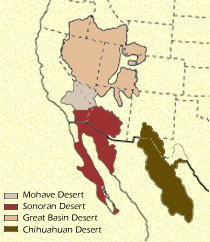
The four Northwestern American deserts
The Slap-up Basin Desert (denture 10) is both the highest-elevation and northmost of the four and has very cold winters. The seasonal distribution of precipitation varies with latitude, but temperatures limit the growing mollify to the summer. Vegetation is dominated by a few species of small, diminished-leafed shrubs; there are almost no trees Oregon succulents and not some annuals. The indicator industrial plant (the most common or marked one used to nam an area) is big sagebrush (Seriphidium tridentatum), which much grows in nearly pure stands over huge vistas. (Such cold shrub/deserts in the "Old World" are called steppes.)
The Mojave Desert Desert (scale 11) is characterized largely past its overwinter rainy temper. Hard freezes are common but not as severe as in the Great River basin Desert. The long vegetation is composed for the most part of dispirited shrubs; annuals rug the ground in wet years. There are many species of these two life forms, but few succulents and trees grow thither. The only general tree species is the characteristic joshua Sir Herbert Beerbohm Tree (Yucca brevifolia), an arborescent (treelike) yucca that forms extensive woodlands above 3000 feet (900 m) superlative.
Though the Chihuahuan Forsake (plate 12) is the south, it lies at a fairly high elevation and is not protected by any barrier from arctic air masses, so hard winter freezes are common. Its botany consists of many species of low shrubs, folio succulents, and decreased cacti. Trees are rare. Rainfall is predominantly in the summer, but in the northern end there is occasionally enough wintertime rain to support massive blooms of spring annuals. The Chihuahuan Desert is unexpectedly rich in species despite the winter cold.
The Sonoran Desert
The Sonoran Desert as currently delimited covers approximately 100,000 square miles (260,000 sq. klick) and includes much of the state of Sonora, Mexico, most of the southern half of Arizona, southeastern California, about of the Lower California peninsula, and the islands of the Gulf of California. Its southern third straddles 30° north latitude and is a horse parallel of latitude inhospitable; the rest is rain shadow godforsaken. It is lush in comparability to most other deserts. The visually dominant elements of the landscape are two life forms that name the Sonoran Wild from the other North American English deserts: legume trees and large columnar cacti. This desert also supports many other life forms, encompassing a lush spectrum of whatever 2000 species of plants, 550 species of vertebrates, and unknown thousands of invertebrate species.
The sum of money and seasonality of rain are defining characteristics of the Sonoran Desert. Much of the area has a bi-seasonal worker rainfall pattern, though even during the wet seasons most days are sunny. From Dec to March frontal storms originating in the North Pacific at times bring widespread, gentle rainfall to the northwestern deuce-thirds. From July to mid-September, the summer monsoon brings surges of wet tropical air and decentralized deluges in the form of slam-bang thunderstorms to the southeastern two-thirds. Thus crisp are the characters of the two types of rainfall that Sonoran residents have different Spanish terms for them. the wintertime rains are equipatas (derived from the Yaqui-Mayo word for rain, quepa), the summertime rains are las aguas ("the waters" in Spanish).
The Sonoran Defect conspicuously differs from the different three North American comeupance in having mild winters. Nigh of the area rarely experiences frost, and the biota are partly parallel of latitude in source. Many of the perennial plants and animals are derived from ancestors in the hot thornscrub to the south, their life cycles attuned to the brief summer rainy mollify. The winter rains, when ample, support great populations of annuals (which fabricate nearly half of the species of our plants). Some of the plants and animals are opportunistic, growing or reproducing after probative rainfall in any season (pick up the chapter "Deep History of the Sonoran Desert" for more details along its evolution).
Subdivisions of the Sonoran Desert
Forrest Shreve was the prototypical mortal to specify the Sonoran Desert by dividing it into cardinal subdivisions, supported the diverse and distinctive vegetation found here. One of Shreve's subdivisions (the Foothills of Sonora) has since been reclassified as foothills thornscrub, a non-desert biome.
Lower Colorado River Valley
Called for its location surrounding the lower Colorado River in parts of four states, this is the largest, hottest, and driest subdivision. It challenges the Mohave Desert's Last Vale A the hottest and driest place in Northwestward U.S.A. Summer highs may exceed 120°F (49°C), with coat temperatures approaching 180°F (82°C). The intense solar radiation from cloudless skies along to the highest degree days and the very contemptible humidity suck the essential water from plants, water that cannot be replaced from the parched mineral soil. Annual rainfall in the driest sites averages less than three inches (76 millimetre), and some localities have gone thirty-six months with No rain. Even off so, liveliness exists here, abundantly in the rare wet years.
The terrain consists mostly of all-encompassing, flat valleys with wide-scattered, small lashing ranges of near desolate rock. There are also seas of loose sand and the spectacular Pinacate volcanic field (see plate 14). The valleys are dominated by low shrubs, primarily coville (L. tridentata) and white bursage (Ambrosia dumosa). These are the cardinal most drought-tolerant perennial plants in North America, but in the driest areas of this section even they are restricted to drainageways. Trees turn only if on the larger washes. The mountains support a wider variety of shrubs and cacti, but the density is still very sparse. Columnar cacti, one of the indicators of the Sonoran Desolate, are thin (virtually absent in California) and are closed to valley floors. Period of time species comprise over half the vegetation, up to ninety pct at the driest sites; they are by and large winter growing species and appear in conspicuous numbers only in soused years (see plate 13).
This is the only part of the Sonoran Desert that extends into California, where most residents call it the Colorado Desert. North of a sagging line between the Coachella Valley (Palm Springs) and Needles, California, it merges near imperceptibly into the glower Mohave.
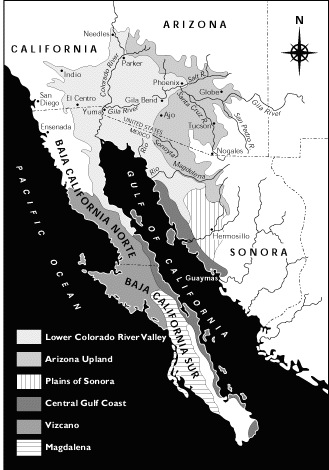
Subdivisions of the Sonoran Desert. The six subdivisions reflect the biological diverseness of this large desert and the fact that information technology has been intensively designed. Each subdivision has a varied mood, topography, and vegetation.
Arizona Upland
This northeastern subdivision is the highest and coldest part of the Sonoran Desert. Located in south-central Arizona and northern Sonora, the terrain contains many mountain ranges, and valleys narrower than those of the Lower Colorado River Vale subdivision. Trees are common along rocky slopes besides as drainageways, and saguaros grow on slopes above the cold valley floors. This community is also known as the "saguaro-Parkinsonia florida forest". Information technology is the only subsection that experiences frequent hard winter frosts, and so many species of the lower elevation and more southern subdivisions cannot survive here. Nevertheless information technology is a rich area. The young range that is the Desert Museum's home, the Tucson Mountains, has all but 630 taxonomically distinct kinds of plants. This richness is partly explained by the two equal rainy seasons which add u twelve inches (305 mm) per yr on the average. The hilly terrain provides a multitude of microhabitats on Second Earl of Guilford and south slopes and distant, murky canyons. The proximity to chaparral, woodland, and grassland communities contributes still more species to the flora (see crustal plate 15).
Biologists are more and more concluding that the Grand Canyon State Upland's climate, vegetation density, and biodiversity resemble thornscrub to a higher degree inhospitable. Wear't be surprised if this subsection is reclassified in the warm future.
Tucson is the only major city located in Arizona Mountainous, although untold of metro Capital of Arizona's parks and land above 2000 feet (600 m) in elevation share its characteristics. Residents who have moved to this domain from temperate climates much complain about the lack of seasons. Really Arizona Upland has five seasons which, though more subtle than the traditional temperate four, are distinguishable if one learns what to look for.
The following description is for Tucson, but is fairly applicable to the rest of Arizona Upland and to the eastern ace-half of the Lower Colorado Valley subsection besides. The seasons are a little later o at high latitudes and elevations, sooner at lower ones. The monsoon is later and more sporadic farther west; in some years it fails to reach the Colorado River.
- Summertime Monsoon, or summer rainy season (primaeval July to mid-September)
-
In localized aboriginal custom, the year begins with the virtually dramatic endure event of the region — the often abrupt arrival of the summertime rains (plate 16). A tropical air volume brings humidity and moderates the temperatures from June's extremes; frequent thunderstorms occur; this is the principal growing season for many of the larger shrubs and trees. (Monsoon is derived from an Arabic word for "mollify", and was practical to a twist that changes directions seasonally. Be aware that it does non advert to rain Oregon storms in and of itself, merely rather to the shift of thread direction which brings moist publicize that can generate storms — in our case, a souther confidential information in July. The word is oft misused, eve aside some weather reporters.)
A sixth season, ripe summer, lasting from mid Grand through September, is sometimes added; this is a radioactive and dry period subsequently the monsoon ends — nonexistent in some years.
- Fall (October & November)
-
Warm temperatures; low humidity; little rain; few species in flower, but the ontogenesis season for wintertime annuals begins if there is enough pelting. Recently summertime and autumn occasionally receive heavy rains from the remains of Pacific hurricanes (tropical storms).
- Winter (December & January; sometimes February)
-
Mostly gay, moderate days, with intermittent storms that work wind, rain, and cool off-to-cold temperatures; February often warm and prohibitionist, more ricoche-like (see plate 17).
- Spring (early to late February through April)
-
Mild temperatures; immature rainfall; often windy; one of two flowering seasons; winter annuals may starting time blooming in February in tender, wet years (see plate 18).
- Foresummer (May & June)
-
Tenor temperatures; same low humidity; no rain in most years; May is very warm and often windy; June is hot and usually calm. There is minute biological activity except for the inflorescence and fruiting of Carnegiea gigantea and desert iron tree. Nearly plants and many animals are dormant until the rains arrive (check plate 19).
Plains of Sonora
This lowly region of central Sonora is a series of identical panoptic valleys 'tween wide separate ranges. Information technology supports denser flora than does Arizona Alpine because there is more rainfall (with summer rain possessive) and the soils are loosely deeper and better. It contains most of the same species as Arizona Upland, plus some tropical elements, because frost is less frequent and less severe. There are abundant legume trees, especially mesquite, and relatively few columnlike cacti. The a few hills in that region support islands of thornscrub. Most of this subsection has been converted to agriculture in the last few decades.
If Arizona Upland is reclassified as thornscrub, the wetter Plains of Sonora subdivision would also accept to be reclassified from desert to thornscrub.
Central Gulf Glide
The Central Gulf Coast occupies a strip along both sides of the Gulf of California. Extremum aridity dictates the distinctive appearing of this subdivision. It straddles the horse latitude rap, and desert vegetation grows honorable to the sea-coast. Small shrubs are nearly absent; their shallow root systems and lack of water repositing cannot sustain them through the droughts which commonly last for several years. Dominating the vegetation are turgid stem-succulents, in particular the monolithic cardón (Pachycereus pringlei, a giant relative of the saguaro), and trees such atomic number 3 palo verde, tree vine cactus (Fouquieria diguetii and F. macdougalii), ironwood, elephant tree (Bursera spp.), and limberbush (Jatropha spp.); the trees are aphyllous most of the time. The intermediate yearbook rainfall of less than five inches (125 millimetre) occurs mostly in summer, though non dependably enough to call it a rainy temper. A twelvemonth with no rain is not rare (see plate 20).
Vizcaino
The Vizcaino branch is on the Pacific side of the Baja Golden State peninsula. Though rainfall is very low, cool, wet sea breezes with frequent fog meliorat the aridity. Winter rain predominates and averages less than five inches (125 mm). This subdivision contains more or less of the most bizarre plants and eerily beautiful landscapes in the macrocosm. There are fields of vast, sculpted white granite boulders or blackened lava cliffs that shelter botanical apparitions such as boojums (Cirio), twisted and egotistic Baja elephant trees (Pachycormus discolor), sixty-understructur (18 m) full-length cardones, strangler figs (Ficus petiolaris ssp. palmeri) that grow on rocks, and blue palm trees (Brahea armata). In stark contrast, the coastal Vizcaino Plain is a matt, cool, fog desert of shrubs scantily a foot tall, with occasional mass blooms of annual species (see plates 21 and 26).
Magdalena
Located in inshore Baja California south of the Vizcaino, Magdalena is synonymous in visual aspect to the Vizcaino but the species are somewhat different. Near of its meager rain comes in summer and the aridity is modified by Pacific breezes. The bleak coastal Magdalena River Plain's only conspicuous endemic plant is the supernatural creeping devil cactus (Stenocereus eruca), but upcountry the bumpy slopes are rich and dense with trees, succulent shrubs, and cacti (see plate 22).
Foothills of Sonora
This was Shreve's ordinal subdivision of the Sonoran Desert. It has since been reclassified as foothills thornscrub community and is no more considered part of the desert biome because of its greater rain, taller trees and cacti, and denser vegetation.
Shreve's portrayal of the Sonoran Desert's edge and subdivisions are the most widely accepted. There are at the least five other major attempts to define this area with dramatically differing boundaries. One version excludes most of Baja California from the Sonoran Wild. Another includes the Mohave as component of the Sonoran Godforsaken. (Indeed, it is difficult to distinguish the two on the presently recognized edge.) These differences of interpretation ruminate the great diversity of geography and biota recovered Here.
The discussion is not yet over. Time will determine whether Arizona Upland and the Plains of Sonora leave remain parts of the Sonoran Desert operating room be reclassified as thornscrub. Whatever they are titled, all of these regions are gripping places for nature lovers, whether they are classified as scientists or tourists.
what biome in north america has the lowest biodiversity
Source: https://www.desertmuseum.org/books/nhsd_biomes.php

Posting Komentar